Recent Discussions

Need help with prelogin Intune deployment
Hello, I need to understand how to get prelogin to work for my environment so users can sign in when off of the network. We are deploying devices from intune using the enrollment status page. So it gets deployed to them, they turn it on and it autopilots from there. The cato sdp client is being deployed with patchmypc and has a script in place with that for the required registry keys. The certificates are being deployed inside of a win32 intune win file with a script to install the certificate. Script for the certificate: yes it is password protected pfx file. (We do not have a certificate authority. (This did work for prelogin on my device.) Import-PfxCertificate -FilePath .\Catoprelogin.pfx -Password (ConvertTo-SecureString -String 'mypassword' -AsPlainText -Force) -CertStoreLocation Cert:\CurrentUser\My All of this was successfully installed, what could I be missing? The certificate is an SSL certificate and I confirmed that it worked prior to the autopilot on my personal work computer without autopiloting it. DOES ANYONE HAVE ADVICE OR SUGGESTIONS ON HOW TO SETUP THE INTUNE AUTOPILOT PROFILE, ENROLLMENT STATUS PAGE, OR ANY OF THE ABOVE TO MAKE THIS WORK? WHETHER IT IS DEPLOYING THE CERT A DIFFERENT WAY OR DEPLOYING THE CERTIFICATE WITH THE CATO CLIENT APPLICATION INSTALL. Thanks,Perschall20221 year agoJoining the Conversation999Views0likes10Comments
Cato SDP Client to be auto intelligent to login instead of manual logging
I have recently migrated from Netskope to Cato Networks. One issue we have noticed is that users need to login once to Cato SDP client and then "Always-on policy" gets enabled. But users are smart, they don't login to SDP client itself as many sites gets blocked as per policy which they don't want so they don't login once also to SDP client thus making us non-compliant as absence of SDP client makes them vulnerable as they can browse malicious sites as well as can upload company data on public sites which typically gets blocked when connected over SDP client. In Netskope, we just had to push agents to the laptop and no user intervention was required, it automatically detects logged in user credentials so there was no scope for user to not login or bypass security controls. Can't we make zero touch experience for user so that there is no room for escape or delay as now we are totally dependent on user.PrakashRIndia1 year agoStaying Involved817Views0likes17CommentsSplit Tunnel basis FQDN/Domain
I am facing some issue wherein I am not able to browse some government site. There was an article on the same as well. As of now , I have configured split tunnel basis exclude IP and I have excluded IP address of one of the website of Government but this is not going to work as I have multiple websites of government which is not opening. Why there is no option to bypass or split tunnel basis FQDN or domain then I can exclude traffic for Government sites as it becomes a task for doing split tunnel basis individual IP address. Is it on road map as well or not?PrakashRIndia1 year agoStaying Involved632Views4likes5CommentsCATO always on
Hi, I am currently deploying Cato across my entire organization, transitioning from Fortinet’s VPN platform to Cato’s ZTNA. We are enabling Always On to enforce the use of Cato for all users. However, this feature requires an initial login from the user. How can I force an end user (who does not use any sensitive company services but still needs enforcement as part of ZTNA) to complete the initial login to the Cato Client? Since we are rolling this out company-wide, I do not want to enforce it for all users, but rather for a specific group. Is there an option to do that? Thanks!Roni1 year agoJoining the Conversation625Views2likes4CommentsSDP manual PoP greyed-out
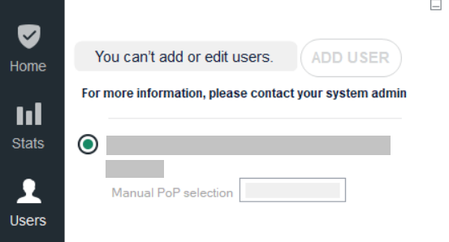
Hello, I can choose manually a PoP on my iPhone, but the option is greyed out on my PC. I can't find on the Cato Management portal where is the setting for that.SolvedCFH1 year agoJoining the Conversation600Views0likes5Comments
about Always-on Issue
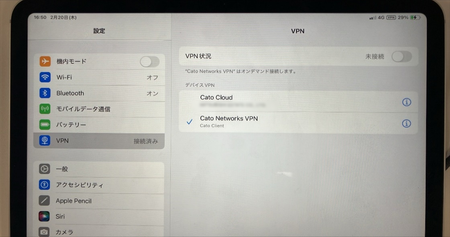
On iOS devices, client certificate authentication and “Always-on” VPN configuration" is created with one configuration profile and distributed through MDM. The Cato Client app is also purchased through Volume Purchasing and distributed through MDM. https://support.catonetworks.com/hc/en-us/articles/360016152418-Distributing-Device-Certificates-to-macOS-and-iOS-Devices-with-Jamf Our user's Cato Client authenticates using the Registration code. Although Cato recommends against creating multiple VPN configurations, once the user authenticates with the Registration code, a second configuration profile "Cato Networks VPN" is automatically created by Cato Client. The problem with this is that users can manually turn off the VPN switch. I can manually delete the second profile, but it will be re-created after a while. This issue is fundamental to the Always-on feature and is so serious that organizations are starting to talk about discontinuing their use of Cato. Does anyone know of a good solution to this problem? shivashiva-SBI1 year agoJoining the Conversation599Views0likes7CommentsBlocking icloud private relay "nicely"
I would like to block "icloud private relay" in such a way that the user would be notified and able to continue without icloud private relay. Apple's recommended way to do this is to block DNS requests to mask.icloud.com and mask-h2.icloud.com so a "no error/no answer" or NXDOMAIN response is returned. This alerts the users that they either need to disable private relay or choose another network. Details are here: Prepare your network or web server for iCloud Private Relay - iCloud - Apple Developer Is there a way to configure this using only Cato? I cannot see how to create a custom DNS rule to block specific queries, and I cannot see how to create a custom IPS rule either. Is there a recommended way to do this? What are others doing? I am in a Windows shop. I could redirect DNS queries to a Windows DNS server and use DNS query filtering, but would rather do a Cato only solution if possible. Per Apple: Some enterprise or school networks might be required to audit all network traffic by policy, and your network can block access to Private Relay in these cases. The user will be alerted that they need to either disable Private Relay for your network or choose another network. The fastest and most reliable way to alert users is to return either a "no error no answer" response or an NXDOMAIN response from your network’s DNS resolver, preventing DNS resolution for the following hostnames used by Private Relay traffic. Avoid causing DNS resolution timeouts or silently dropping IP packets sent to the Private Relay server, as this can lead to delays on client devices. mask.icloud.com mask-h2.icloud.comddaniel10 months agoStaying Involved501Views2likes7Comments- Aiman1 year agoJoining the Conversation500Views0likes3Comments

Clarification on Bandwidth Limit with Split Tunnel Policy
Hi CATO Community, I have a question regarding the CATO Bandwidth limit in relation to split tunneling policies. I have purchased a 25 Mbps CATO Bandwidth plan. If an SDP Client connects to the CATO Cloud and I configure a split tunnel policy to route some traffic outside of CATO Cloud (e.g., directly to the internet), will this traffic still be limited to the 25 Mbps bandwidth cap? 2, If the traffic is indeed limited, is there any method to bypass this limit for split tunnel traffic? Specifically, I want the split tunnel traffic to bypass the CATO Cloud entirely, avoid any security checks, and enjoy the full speed of our original internet connection. I would appreciate any insights or advice from those who have experience with this configuration. Thanks in advance for your help!lo1 year agoJoining the Conversation400Views0likes1Comment