Block/prompt based on risk rating
For Generative AI services, we would like to present the "Prompt" action for services that have a risk rating of 3 and less as per the Cato App catalog, and "Block" those with risks 4+. To our slight surprise there does not appear to be a "Prompt" option in the App & Data Inline Protection module. Is there a way to work around this that does not include having to manually populate the list of "risky" service?268Views0likes7CommentsRecording: AMA with Professional Services - November 2025 Session 2
In our last AMA with our Professional Services team we dove into two major topics: TLS Inspection and CASB/DLP. These features are critical for improving visibility, securing encrypted traffic, and protecting sensitive data. If you missed the session, don’t worry! We’ve summarized the key points and answered your most pressing questions below. (Slides from the presentation are attached for deeper detail.) Presentation Highlights TLS Inspection Why it matters: Over 90% of internet traffic is encrypted, which is great for privacy but creates blind spots for threats like malware and phishing. Benefits: Organizations enabling TLS inspection block 52% more malicious traffic. Challenges: Complexity, operational burden, and compliance concerns often slow adoption. Cato’s approach: Cloud-native TLS inspection with Safe Mode simplifies rollout, minimizes disruption, and includes automatic bypass lists for problematic apps. Best practices: Block QUIC/GQUIC, manage bypass lists, and roll out gradually in phases. CASB & DLP Purpose: Protect sensitive data, ensure compliance, and gain visibility into SaaS usage. CASB: Focuses on application control—monitoring activities like uploads/downloads and enforcing granular policies. DLP: Adds content inspection to prevent data leaks based on patterns, sensitivity labels, or custom rules. Implementation: Start with monitoring, then enforce policies gradually. TLS inspection is a prerequisite for both. Q&A Highlights Q1: Is TLS Inspection becoming more popular? Yes! Adoption has improved significantly since the introduction of Safe TLS Mode, which uses a wizard to simplify configuration and automatically applies recommended bypasses. This reduces risk of breaking apps and makes rollout less intimidating. Q2: What about mobile apps using QUIC? QUIC-based apps (e.g., WhatsApp, Jira) can pose challenges. Recommendations include: Verify automatic bypass settings for native apps. Block QUIC/GQUIC to force fallback to TCP for inspection. Apply exceptions only when necessary. Q3: Will users get notified when DLP blocks an action? Currently, notifications are basic, but enhancements are planned. Soon, users will see alerts like “Action blocked due to company policy” via the client, with more detailed CMA alerts coming later. Q4: Can we filter CASB activities like upload/download? Yes! The Cloud Activity Dashboard shows top activities and allows filtering by action (e.g., upload). You can also drill down into events for detailed visibility. Q5: Is AWS GovCloud supported for log integration? Not at this time. The current integration works with standard AWS S3 buckets. GovCloud support is a common request and may be addressed in future updates. Q6: Any update on combining SDP and EPP into one app? It’s on the roadmap, but no detailed timeline yet. Q7: How to handle bandwidth spikes during patching? Use Bandwidth Management to map update traffic to a lower-priority queue, ensuring critical apps maintain performance during bursts. Thanks to everyone who joined and asked great questions! If you have ideas for more content that we can create that will be useful to you and your team, feel free to leave us a comment or email our community team at community@catonetworks.com. Stay tuned for our next AMA in February :) bring your questions and your favorite warm beverage! 119Views1like0Comments
Cato Connect Event: AMA with Professional Services - November 2025
Did you join our last AMA with Professional Services and want more? Did you miss the last one and have been waiting for us to drop more dates? Well your request is our command, and we are back with another event for our customers and partners. We're doing things a little differently this time: First of all, we'll be honing in on specifics around CASB and TLSi, we will even have a short demo at the beginning to help you start using, or get the most out of, your investment. (We'll still take general questions from the audience) The other change is that this time, we're offering ~*options*~ Join us on: November 4th, 2025 at 3pm HKT or November 6th, 2025 at 11am EST During this live AMAs with members of our talented Professional Services team we’ll cover topics like: The latest versions of TLSi and CASB Best practices we’ve seen across real-world environments Your questions... seriously, bring them Here’s how to get the most out of it: Register for the November 4th or November 6th meetings and get the calendar invite and join us live Post your questions below in the comments — we’ll answer pre-submitted ones first, before tackling live chat during the session + See a question you like? Give it a “like” to help it rise to the top Note: We won’t be able to look at specific CMA instances — demos will be done using internal environments. That’s it — register, post your questions, and we’ll see you there! Presenters: Steven Wong Professional Services Engineer Kushtrim Kelmendi Principal Consultant Professional Services, EMEA Martin Guerrero Commercial Sales Engineer If you run into any issues, @mention me or email us at community@catonetworks.com307Views4likes0Comments
Tenant Restriction for Box
Hi Community, I would like to use the tenant restriction feature in CASB to limit Box access to specific tenants. https://support.catonetworks.com/hc/en-us/articles/24373653275165-Managing-Tenant-Restrictions-for-SaaS-Apps After checking Box's public documentation, I could not find information on the parameters to insert into the HTTP headers. Are there anyone using tenant restrictions for Box?108Views0likes1CommentSpeaking Opp for Cato CASB Power Users
Hey Cato Connect! We’re gearing up for our next CASB webinar — and we’d love to spotlight one of YOU. Are you using Cato CASB and passionate about how it’s helping your organization? This is a great chance to share your journey, insights, and real-world wins with a broader audience. Interested in speaking? Let us know! We’re looking for a customer to join us on the virtual stage and bring the customer perspective front and center. Not a CASB user (yet)? No problem! We'd still love your input — tell us what CASB-related topics you'd find most valuable to hear about. We'll do our best to cover them during the session. Drop your ideas or interest in the comments below — or email me directly at zoe.averbuch@catonetworks.com. Let’s co-create a session that’s practical, relevant, and community-driven. 🙌47Views0likes0CommentsCato Rapid Recap | June 2025
📣 Cato Rapid Recap | June 2025 Staying current on the latest features, best practices, and platform improvements isn’t always easy. That’s why I’m kicking off a new 2-minute monthly recap — designed to help you: ✅ Quickly catch up on what’s new ✅ Share relevant updates with prospects, POCs, and customers ✅ Stay aligned on Cato’s evolving value 📅 Plan is to release this every month — short, actionable, and easy to share. ▶️ Watch the June Recap Got feedback or requests for next month’s recap? Drop a comment below 👇80Views2likes0Comments
Is the App Activities Integration for MS Apps unavailable with the M365 Business plan?
Hi, I would like to visualize data within M365 using App Activity. According to the following online document, it seems that a "Microsoft 365 E3 license" is required. Could you please confirm whether this feature is not supported with "Microsoft 365 Business Premium" ? Reference: Microsoft Apps (Including Copilot): Configuring the App Activities Integrations https://support.catonetworks.com/hc/en-us/articles/24373065734045-Microsoft-Apps-Including-Copilot-Configuring-the-App-Activities-Integrations Thank you in advance.Solved95Views0likes1CommentWhat is the difference between App Control Rule "Allow + Tracking: Event Enable" and "Monitor"?
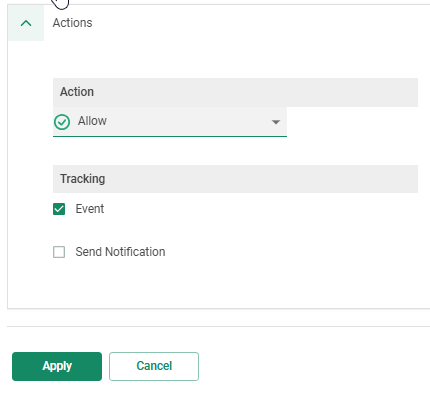
In the *App & Data Inline* -> *Application Control Policy*, we have configured the rule as follows: - **Action: Allow** - **Tracking: Event** (Enabled) However, under this configuration, **no events are shown in the Events screen**. Is this the expected behavior? We are confused because there is also an **Action: Monitor** option, yet "Allow" can also be configured with Tracking enabled or disabled. Could you clarify the functional difference between these two actions and how they affect event logging?205Views1like5Comments